
I drove 2600 miles for a loom
Something Julia Cameron talks a lot about in The Artist’s Way is being on the lookout for “synchronicities.” Things like, you write down in your morning pages that you wish you had more sketchbooks so you might draw more. Then on your birthday, multiple friends get you sketchbooks without knowing this was a secret wish of yours. (This happened to me.)
Or how you might talk to your friend about wanting to try dyeing yarn for the first time as a part of a big, ambitious project you have in mind. And then you go to the thrift store the next week and there on one of the overcrowded bookshelves, as if on display just for you, is a book from the 1970s of over 200 recipes for natural dyes for yarn. (This also happened.)
Or how you might be scrolling Instagram, as you do too much of, and see a post from a well-known tapestry weaver, whose book you own and whose work you admire, that she is selling one of her upright tapestry looms. The kind of loom that has been on your dream list for a while; the kind that are no longer manufactured as far as you know, but which are much more robust and capable than the frame looms you’ve had access to since you started tapestry weaving. (You guessed it: this also happened.)
At another time, I might have seen that post about that loom and thought, Oh wow my dream loom, that’s cool! and scrolled by because I couldn’t begin to imagine how I’d be able to get it, transport it, or afford it. Or I’d assume someone else had scooped it up, someone much more qualified than me to be the next owner of the loom of such a prolific weaver.
But because I was currently reading The Artist’s Way with my friends, and on the lookout for synchronicities, I saw the loom and thought: Oh. That might be for me. I found the courage to reach out to the weaver to ask if the loom was still available (it was), where she was located (northern Georgia—20 hours drive away from me in northern Minnesota), and how much the loom would cost (a very affordable price for a lifetime dream loom).
We spent a day going back and forth about logistics, timing, and loom measurements, while I went back and forth with my partner about the same details. I also happened to have a get together with some of the women I was reading The Artist’s Way with. I walked in and said, “You guys: is it insane to drive across the country for a loom?”
“No!! It’s perfectly normal!!!” they fibbed encouraged. I explained it all, answered some of their valid questions like, do you have room for it? The answer: not really, but I’ll make room. I asked them to vote, and being artists themselves, and good friends, obviously all voted yes.
Within a matter of days, my boyfriend and I squeezed in the unexpected weeklong cross country roadtrip over the week of Thanksgiving. Naturally, one of the news headlines for that exact timeframe was “Cross Country Storm Threatens Record Thanksgiving Travel Rush.” We drove through pouring rain, snow, and sleet, staying in hotels and adding family visits along the way until we reached the winding mountain roads of northern Georgia and the little town of Dahlonega, where Tommye McClure Scanlin welcomed us into her studio.
It was a little like stepping into a dream. Yarn, books, looms, and tools filled the space in a way that felt warm and purposeful, not cluttered. Textiles, both hers and those she’d collected from other weavers, covered every surface. And there in the center was the Crisp Ruthie high-warp tapestry loom: our reason for being there.
Made sometime in the 1970s-80s of beautiful dark cherry wood, the loom, which I’ll just refer to as Ruthie, stands over 70 inches tall (not 70 feet, as I accidentally told some of my friends with excitement before the trip) and has a weaving width of 60 inches wide. Unlike my frame looms, it has adjustable ends per inch (which allows me to work in finer detail), two shafts and three sets of pedals, and a long bench with a sliding seat, which enable the weaver to create sheds and slide back and forth across the width of the loom to weave on different sections.
As Tommye began to show me how the loom works, it dawned on me that I had never gotten to spend real time with a tapestry weaver. I know many wonderful weavers, some of whom weave tapestries in addition to other things. But Tommye has focused on tapestry for decades, and is incredible at her craft. To get to ask her “How many ends per inch is this?” about all her weavings, and to have her point to one of her magnificent, massive, detailed tapestries on the wall and say, “This was woven on the Ruthie!” was more moving than I could have expected. I had thought and stressed so much about just getting to Georgia, I hadn’t thought a whole lot about actually being there, and being there was turning out to be very special.
Wesley and I spent the night disassembling the loom. We labeled every part down to each nut and bolt as we took it apart, worrying over fitting it in the pick up truck (we did, but not the way we planned). We took breaks to peer closely at the tapestries covering the walls, marveling at the detail. I’d never gotten to spend time with many tapestries that weren’t made by my own hand. I came away with not just a loom, but a sense of excitement at all the things I have yet to learn, and the hope that with a lifetime of work, I too can have a studio full of inspiration one day.
The next morning, we tightened the straps one last time around the loom, spent some time with then said goodbye to Tommye, and headed back north, stopping for a quick hike on the Appalachian Trail. We didn’t have much time to spend—I had to get back to Minnesota to drop off some work at a gallery, and then back to Grand Marais to teach—but we wanted to experience some of that part of the country while we were there. It was beautiful.
Three days and 1,300 more miles later, back in the deep cold of northern Minnesota, we unpacked the pieces of the loom and even though we were exhausted, couldn’t wait to set it up. Aurora inspected the pieces and we moved furniture to make room for Ruthie in my weaving corner, next to the fireplace. She fits, just barely. The loom is home.
In the days afterward, we agreed the entire trip was sort of surreal. It came together so fast that it almost felt like it didn’t happen. The only indication that it really did happen: the massive loom, continued support from Tommye from afar, and now, the first colorful tapestry unfolding.
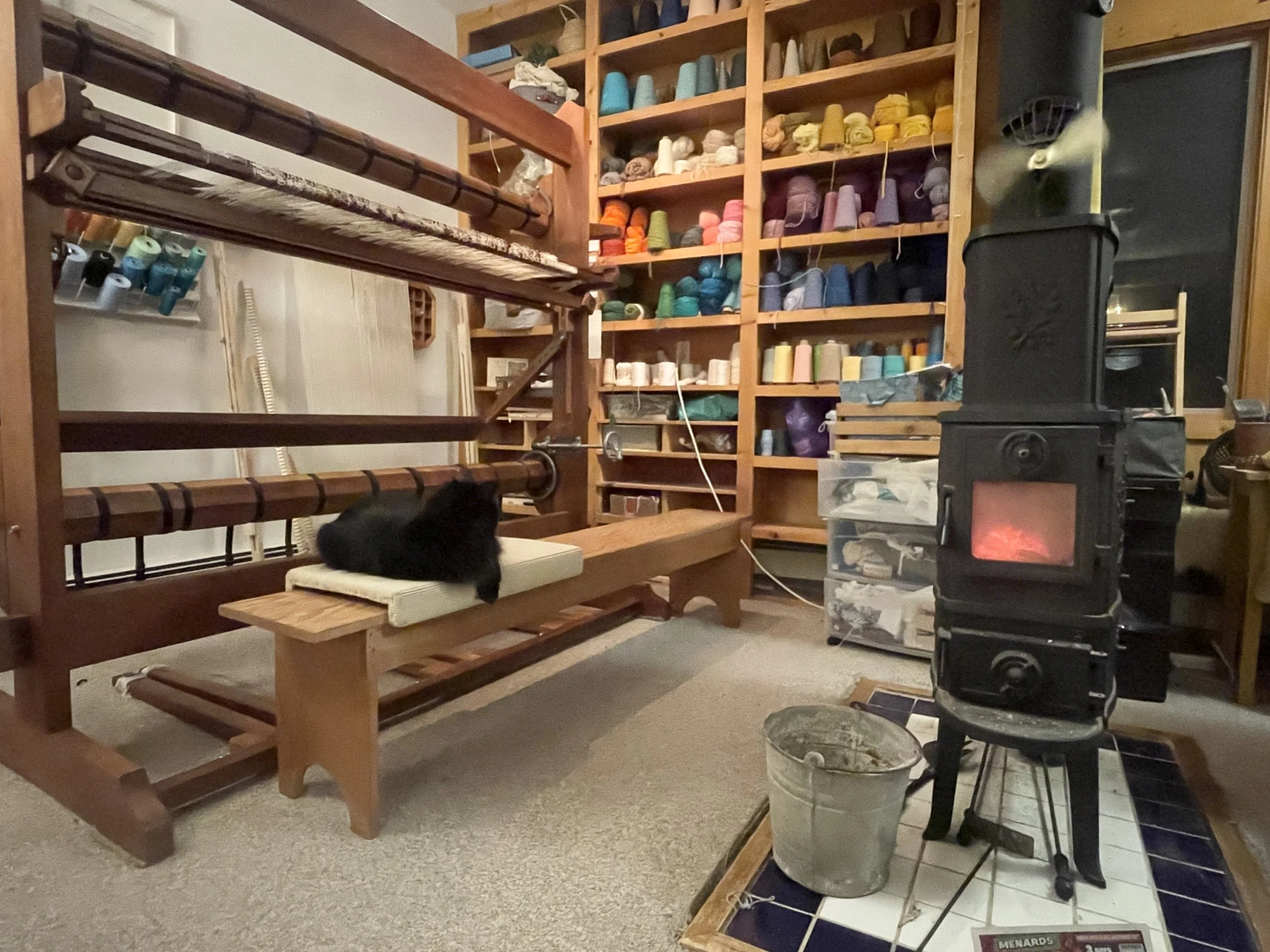
The loom in my studio!